
Over peak tourism season in December 2025 and January 2026, Cape Town received 1,12 million visitors, a 10% year-on-year increase in international tourists arriving, and a 7% increase in domestic tourists. For small, community-based food businesses, this seasonal boom has largely bypassed the city’s backstreets. Most visitors gravitate toward the establishments offering luxury and fine-dining, leaving many local entrepreneurs excluded from the growing market.
In response, Unexplored Cape Town is collaborating with key tourism stakeholders, including the Western Cape Department of Economic Development and Tourism to reflect on the impact of the peak season and explore how the City’s booming tourism economy can be reshaped to benefit historically excluded local food entrepreneurs. Also partnering with Hasso Plattner School of Design Thinking Afrika at the University of Cape Town (UCT) for their flagship Design Thinking Week programme, Unexplored Cape Town presented two challenge statements to students, encouraging them to apply a design thinking process to explore possible solutions for more sustainable and inclusive tourism in the City
Nowadays, travel choices are influenced by food, with around 80% of travellers researching the culinary landscape before choosing a destination. Despite the sector’s overall growth, a complex reality of gentrification and inequality means many small, local businesses are being pushed out or left behind. Tourism 2.0 is Unexplored Cape Town’s answer; a model that demands tourism move beyond consumption and become an enabler for inclusion, by embedding principles like fair revenue distribution, honest storytelling, and long-term community partnerships into every itinerary.
Local government buy-in for a more sustainable and inclusive tourism sector
Solidifying its position as a leading voice in equitable tourism, Unexplored Cape Town was recently invited by the Western Cape Department of Economic Development and Tourism to present its Tourism 2.0 model at the #WCTGWorkshop2025. The presentation reached over 300 tourism-sector stakeholders, providing practical, actionable recommendations on inclusion and equity in food tourism.
“Tourism 2.0 is a framework of immediate actions for travel operators who are serious about responsible travel,” says Dennis Molewa, founder of Unexplored Cape Town. “We presented core principles that integrate desirable sustainability initiatives, from inclusive hiring and fair revenue distribution to ensuring heritage preservation and honest storytelling. This approach demands we move past the extractive nature of tourism towards long-term partnerships that includes local community food businesses and entrepreneurs.”
Unexplored Cape Town partners with the d-school Afrika as a Design Thinking Week project partner
Recognising that meaningful change requires rethinking tourism from multiple perspectives, Unexplored Cape Town recently designed a challenge with the Hasso Plattner d-school Afrika at UCT for Design Thinking Week, which is the flagship programme for d-school Afrika. The dual challenges focused on both the business and customer experience:
- Business-focused challenge: How we could redesign the local food tourism experience in Cape Town to be more inclusive for black and brown-owned local and diaspora businesses in a local tourism space that often excludes marginalised food spaces leading to cultural erasure and loss of social heritage.
- Customer-focused challenge: How we could redesign the local food tourism experience in Cape Town for residents and visitors so they can discover, connect with, and experience local diverse food businesses in a world where mainstream or commercialized offerings often leave these businesses hidden or overlooked.
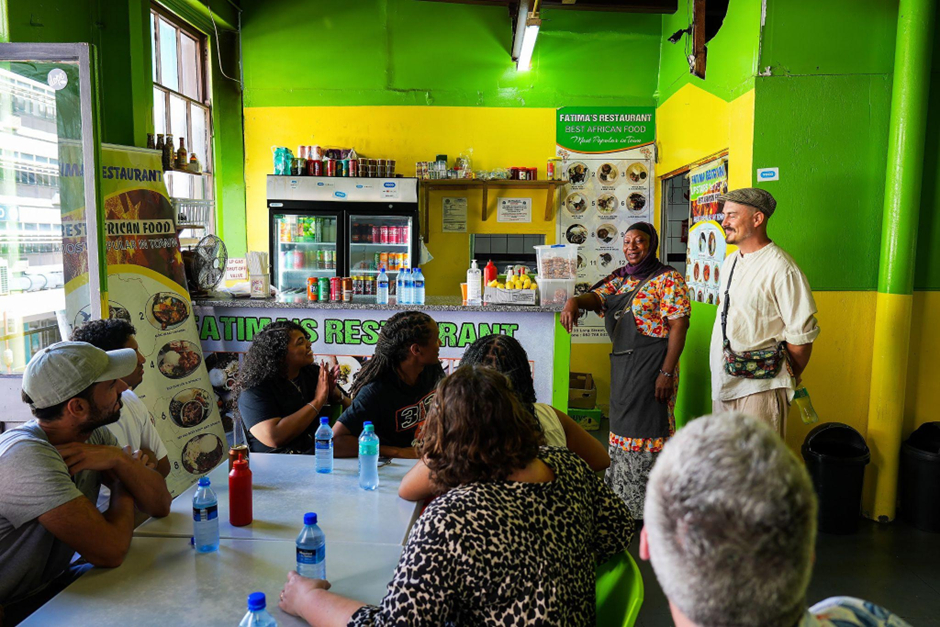
Taking up this challenge, more than 49 multidisciplinary students immersed themselves in the inner city, visiting various vendors, including a Somali community restaurant, a Senegalese dark kitchen, and diaspora-owned kitchens. The challenge was designed to introduce participants to design thinking mindsets and processes, and how these can be applied to the challenge statements, and ultimately impact Tourism 2.0. Throughout the week, students explored the challenges faced by black, brown, and diaspora-owned local food businesses. They stepped into real stories, connected with real people, and gained a deeper understanding of the lived experiences behind the problem.
This fieldwork initiated a process for students to explore possible directions and early concepts’ ranging from digital onboarding tools and QR-code systems for small kitchens to ideas for heritage-food markets and collaborative food ventures.
“If I learned one thing about design thinking, it’s that there is never just one problem, and never just one solution,” Molewa shares. “The challenge unlocked a process to explore different solutions, which will ultimately help us chart a multidimensional path forward where culture, economy, identity, and community intersect.”
These exploratory concepts offered by the students will contribute to the broader thinking that may help inform the direction of Unexplored Cape Town’s African Food Business Fund. This is a newly formed non-profit committed to supporting marginalised, heritage-based African food enterprises in Cape Town through sustainable business development, digital empowerment, and community partnerships.
“After the challenge I joined Unexplored Cape Town for their African Food and Storytelling Experience. I ate with my hands and explored the CBD through the eyes of local business owners. As an African diaspora, it was truly wonderful to experience the rich history of Cape Town and truly out-of-this-world Pan-African food,” shares Samira Matan, Human-Centered Designer and MSc student at UCT
“The figures from this past December prove that Cape Town is a global culinary magnet. However, as the peak season winds down, we must ask: who actually benefited? Our work with local government and academia is about ensuring that by the time the next surge arrives, we have moved from a model of consumption to one of true community-led restoration.”
For more information, please visit: https://unexplored.co.za/african-food-business-fund/
To access any high-res images or footage, please click here.