
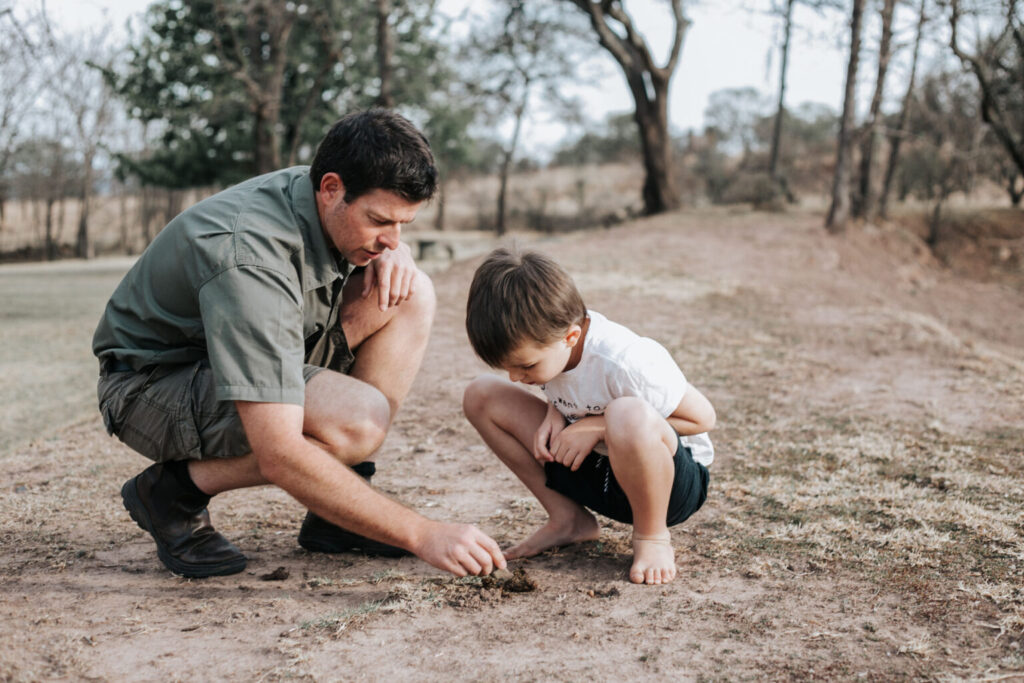
How Child-Centred Tours Are Transforming Wildlife Tourism
By Katie Wormald | Co-Owner & Director, The Little Bush Baby Company | KwaZulu-Natal, South Africa
The safari industry has long been built on the pursuit of the Big Five, with the assumption that the experience begins and ends with the game drive. But something is shifting in the African bush, and it is being driven not by seasoned wildlife enthusiasts, but by a generation that does not yet have a credit card.
Generation Alpha, children born from 2010 onwards, are already reshaping family travel in ways the industry is only beginning to understand. They are not passive passengers on their parents’ itineraries. They are co-decision-makers, curious questioners, and increasingly the reason a family books a particular safari in the first place.
For operators in KwaZulu-Natal and across southern Africa, this signals an urgent opportunity: the families who will define the next decade of wildlife tourism are looking for something the traditional safari has rarely been designed to deliver. They want the safari to go slow.
“Children are not simply passengers on a game drive. They are the lens through which a new generation of conservation advocates is formed.”
The Gen Alpha Effect on Family Travel Decisions
The data is unambiguous. A 2024 survey by Beaches Resorts found that 85% of Gen Alpha children have direct input into where their family travels for holiday. Hilton’s 2025 Trends Report, drawing on responses from over 13,000 global travellers, revealed that 56% of families now select accommodation specifically based on youth programming and children’s club offerings, and that 63% of parents regularly allow their children to determine where the family dines while travelling.
These are not marginal preferences. They represent a structural reordering of how family travel decisions are made. The parent is no longer the sole architect of the itinerary; the child is a stakeholder. And what Gen Alpha stakeholders want, above all else, is not speed, spectacle, or social media aesthetics. They want to understand things.
Born into a world of climate anxiety, digital immediacy, and an overwhelming awareness of ecological fragility, Gen Alpha children are arriving at safari lodges and wildlife reserves with a depth of prior knowledge and a depth of expectation that the industry has never encountered before. They have watched nature documentaries on demand. They have engaged with virtual conservation content. They know what a pangolin is. Now they want to meet one.
What ‘Slow Safari’ Actually Means
The concept of slow travel, immersing deeply in a single place rather than rushing between destinations, has gained significant traction across the wider tourism sector. Hilton’s 2025 research notes that one in four global travellers now seeks cultural learning experiences as a primary travel motivation. For families travelling with Gen Alpha children, this instinct takes a specific and powerful form in the African wilderness context.
A slow safari is not a shorter game drive, nor a stripped-back experience. It is a recalibration of what the safari is designed to deliver. Where the conventional safari asks, ‘What will we see?’, the child-centred slow safari asks, ‘What will we learn?’ The difference is profound and it changes everything from route planning to guide selection to the structure of a day’s programme.
In practice, slow safari elements include junior ranger programmes where children earn badges through field identification and conservation challenges; guided bush walks tailored to children’s eye levels and attention spans; insect hunts, animal track casting, and seed planting; cultural village interactions; and conservation storytelling around the fire. Many leading operators in South Africa have been quietly developing these offerings for years. What is new is the demand-side pressure now pushing them to the foreground.
As Good Earth Tours and other South African family safari specialists note, the most successful child-centred experiences combine shorter, focused game drives with structured in-camp learning activities, acknowledging that a nine-year-old’s optimal engagement window differs fundamentally from that of an adult. This is not a limitation of the child; it is an invitation to design more creatively.
“Africa is not a backdrop for a family holiday. It is a classroom without walls, and Gen Alpha already knows it.”
Conservation Education as the New Luxury
There is a generational irony playing out in the premium safari market. For decades, luxury in wildlife tourism was defined by thread counts, sundowner selections, and proximity to the Big Five. For the families now booking three or more international trips per year (64% of Gen Alpha families travel internationally at least twice annually), luxury increasingly means access to meaning.
Operators such as andBeyond have recognised this shift, embedding conservation education programmes that connect visiting children with local school learners, guided by professionally trained rangers and purpose-built workbooks. Over 7,000 children have participated in andBeyond’s Conservation Lessons programme to date. Wilderness Safaris has built its entire brand positioning around an ‘Educate, Empower, Protect’ impact model that explicitly positions the child visitor as a future conservation leader.
These are not add-ons. They are increasingly the product. For smaller boutique operators, particularly those working in regions as ecologically rich as KwaZulu-Natal, they represent the most powerful differentiator available.
KwaZulu-Natal offers extraordinary assets for child-centred wildlife tourism: iSimangaliso Wetland Park, South Africa’s first UNESCO World Heritage Site, containing nesting turtles, flamingos, hippos, and crocodiles; the St. Lucia estuary system; the elephant populations of Hluhluwe-iMfolozi; the coastal whale migration routes. These are not merely scenic. They are pedagogically extraordinary. A child who watches a humpback whale breach off the KZN coast, guided by a marine biologist who explains the migration route, does not simply see a whale. They begin a relationship with the ocean that may last a lifetime.
What the Industry Must Prepare For
The implications for wildlife tourism operators, DMOs, and lodge developers are considerable and immediate.
First, guide training must evolve. The child-centric safari requires a guide who can hold the attention and imagination of a seven-year-old without losing the engagement of their parents. This is a distinct professional skill, closer to environmental education facilitation than traditional guiding, and it requires deliberate investment in training and qualification.
Second, itinerary design must become age-responsive. Families with children under twelve are not the same market as families with teenagers, and neither is the same as the adult-only wildlife traveller. Operators who build age-segmented programme options rather than offering a single ‘family-friendly’ game drive will have a significant competitive advantage.
Third, the digital dimension cannot be ignored. Gen Alpha children are the first fully digital-native generation; they have grown up with algorithms, gamified learning, and interactive content. The safari experience that begins and ends at the reserve boundary misses an opportunity. Operators who offer pre-arrival digital content, post-visit conservation updates, or junior ranger digital badges are building relationships and future bookings that extend well beyond the stay.
Finally, the values alignment that Gen Alpha families seek is non-negotiable. Research consistently shows that younger consumers, including the millennial parents of Gen Alpha, respond to genuine sustainability commitments over performative greenwashing. Operators whose conservation impact is measurable, community-embedded, and transparent will earn the loyalty of this market in ways that five-star amenities alone cannot.
Conclusion: Africa Is Already Ready
The safari industry sometimes speaks of Gen Alpha as a future market, something to prepare for in the decade ahead. The reality is that Gen Alpha is already travelling, already influencing, and already choosing. The eight-year-old on this year’s safari is the twelve-year-old who will tell their school friends where to ask to go next year, and the twenty-something who will book their own conservation volunteer experience in 2035.
Africa does not need to be invented for Gen Alpha. It simply needs to be revealed, slowly, attentively, and with the deep respect for wonder that the African bush has always, in its best moments, inspired. The operators who understand this are not merely selling a product. They are building the next generation of Africa’s most powerful conservation advocates.
The safari has always been, at its heart, a story about transformation. It is time to write that story for the youngest travellers in the vehicle.